
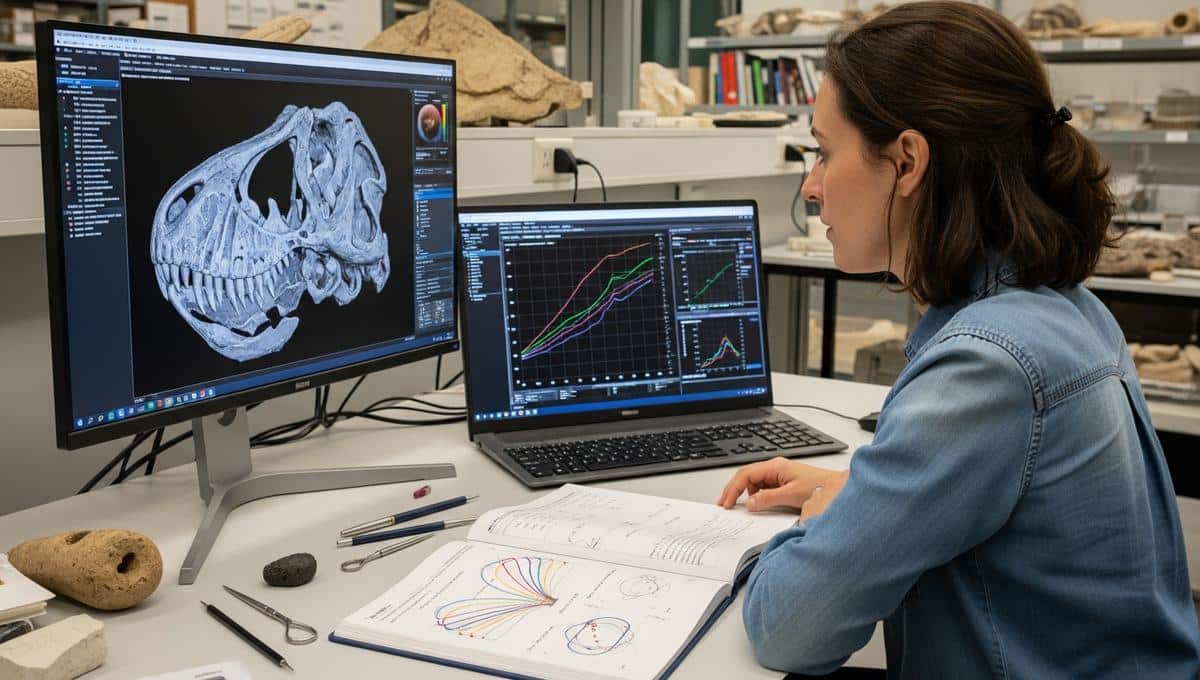
A new study offers a sharper look at a giant hunter’s rise to dominance. The findings detail how size, growth, and design combined in T-rex without relying on hype or myth. As a result, readers get a grounded picture of a predator built for control.
A fresh analysis of a fearsome hunter
The research re-examines bone microstructure and body proportions across life stages. By reading growth rings, scientists track how tissue changes map to strength and function. Thus, the team links development to performance rather than headline-grabbing traits. The approach favors testable evidence and careful comparisons.
Instead of asking only how big it got, the work asks how it got there. That lens matters for T-rex because power and balance emerge step by step. In fact, juvenile frames, adolescent spurts, and adult robustness form a single story. Each phase laid groundwork for the next.
Growth that builds control
Young animals stayed light and quick, which likely reduced risk while they learned. Then, a rapid adolescent surge added mass where it mattered most. Therefore, hips, tail base, and skull buttressing matured together for stability under load. The result is a body tuned to subdue struggling prey.
« Growth patterns can explain how power scaled up without sacrificing control. »
Muscle reconstructions place major engines near the pelvis and tail. That architecture counters torque when a large prey animal twists or bucks. Thus, the head could apply force while the core kept balance. In practice, T-rex turned weight into leverage.
To readFlu spreads more through the air than by touch, new study showsBone textures reveal episodes of remodeling consistent with repeated high stresses. Healed marks and dense reinforcements align with a life of forceful bites and clashes. Consequently, the skeleton reads like a diary of strain and recovery. Such evidence supports a strategy built on holding, not sprinting.
- 68–66 million years ago: the final act of large tyrannosaurs in North America
- Adult size often near 12–13 meters from snout to tail tip
- Estimated mass in the range of 6–9 tonnes, depending on specimen
- Bite force modeling above 35,000 newtons on conservative estimates
- About 60 stout, serrated teeth adapted for resisting bending
Senses, skull, and the physics of a bite
Multiple lines of evidence point to keen sensory tools. Enlarged olfactory bulbs suggest a strong sense of smell. Meanwhile, forward-facing eyes would aid depth judgment at close range. Together, these traits help a hunter place a bite where it counts, even under pressure.
The teeth were not daggers; they were load-bearing “bananas” with thick enamel. As a result, they crushed and tore instead of slicing cleanly. That design creates cracks that run through bone and tendon. It also reduces the risk of tooth failure during violent struggles.
Skull architecture balanced stiffness and controlled flex. Reinforced joints limited twist where stability mattered most. Yet certain seams likely allowed tiny movements to spread stress. Thus, the head acted as a robust tool rather than a brittle hammer.
Speed, stability, and strategy
Speed estimates vary, but the body plan favors steadiness over sprinting. Long legs still cover ground efficiently over time. However, the center of mass and tail suggest careful maneuvering under load. In that frame, T-rex wins by keeping hold rather than chasing flat out.
Energy economy likely played a role in daily success. Therefore, endurance, patience, and timing may have beaten raw speed. Pack behavior remains debated, so the safest view focuses on the individual. Even so, coordinated tactics are plausible for subadults during transitions.
Ecology through the life cycle
Ontogeny opens a window on food webs. Juveniles probably targeted smaller, quicker prey they could handle safely. Adults, by contrast, shifted to big game that rewarded control and power. This partitioning reduces direct competition within the species across ages.
Hunt versus scavenge is a false choice when energy rules survival. Fresh kills and carcasses both fit a flexible strategy. Signatures on fossil bones show bites linked to both behaviors. Thus, the animal acted as an opportunist with elite tools for close combat.
To readAttic insulation: a simple weekend upgrade that cuts energy bills this winter by up to 30%Put together, the data describe a regulator of Late Cretaceous ecosystems. The predator’s growth plan forged a sturdy, efficient engine of control. As a result, prey behavior, migration, and herd structure likely shifted around it. In the end, T-rex shaped the stage as much as it played upon it.
Crédit photo © DivertissonsNous