
For years, many of us pictured the flu leaping from coughs to hands to doorknobs. Yet new field research suggests the picture is far more airborne than we assumed. In practical terms, this changes how families, schools, and workplaces can prepare.
What a hotel experiment reveals about airborne spread
Researchers at the University of Maryland set up a careful, real‑world study on an isolated hotel floor in Baltimore. They observed how people mixed during conversations, group activities, and shared tasks. Crucially, they tracked interactions while limiting outside contamination. As a result, they could test competing ideas about how infections move.
Participants talked, did yoga and dance sessions, and handled shared objects such as a tablet and a microphone. In parallel, some individuals wore FFP2 or N95 masks, which are designed to filter fine particles. Because the setting was controlled, researchers could compare outcomes across different behaviors. The approach adds weight to the evidence that air matters most.
Inside the study design and what participants did
The team focused on close‑range encounters and routine indoor sharing. In fact, the goal was to see how much transmission could be explained by breathing the same air versus touching the same items. Their protocol included repeated social moments, not just brief contact. That focus makes sense for the everyday places where flu risk adds up.
« This study challenges the old contact-versus-droplet split and puts air back at the center. »
Observers documented how long people stayed together, how they moved, and what they touched. Moreover, they noted mask use, distance, and ventilation practices on site. Such details help decode why some encounters lead to infection and others do not. Consequently, the findings can inform practical guidance rather than lab‑only advice.
What this means for everyday settings
The emerging signal is consistent: inhaling shared air appears to drive a large share of risk during flu season. Therefore, reducing exposure to fine aerosols becomes a primary line of defense. Well‑fitted FFP2 or N95 masks can cut inhaled dose during close contact. By contrast, frequent surface touch alone seems less central than once believed.
- Ventilate rooms to refresh indoor air.
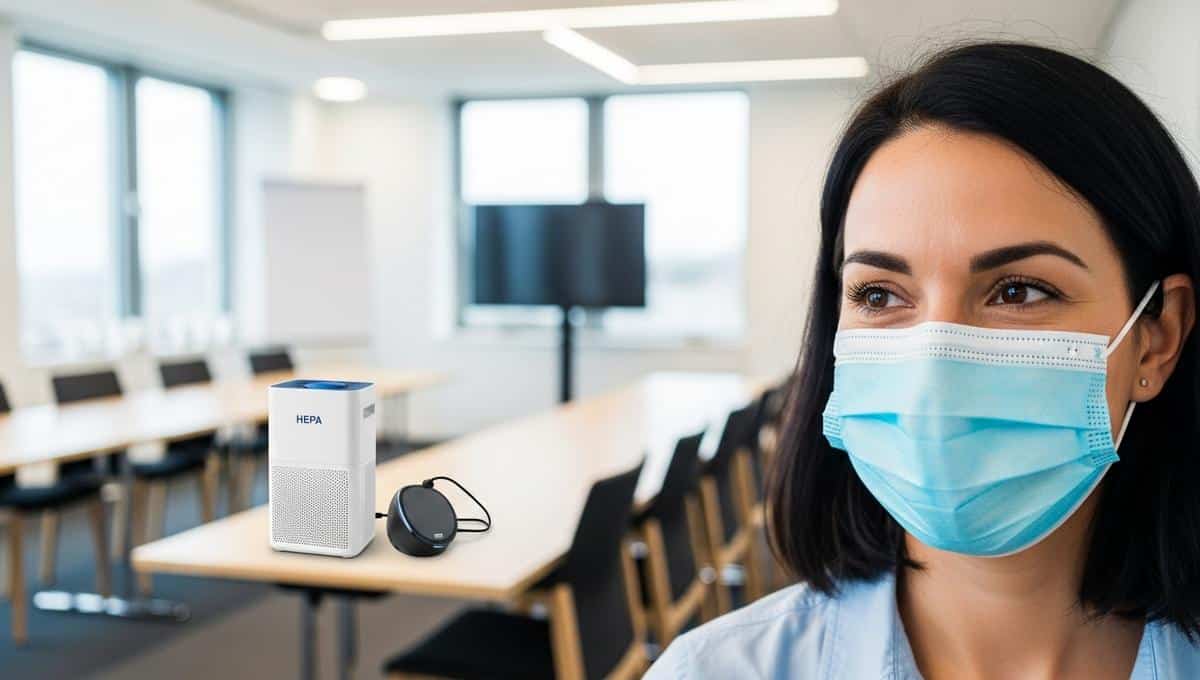
- Filter with portable HEPA units when windows stay shut.
- Mask smartly with FFP2 or N95 in crowded rooms.
- Stay home when symptomatic to break chains.
- Wash hands to reduce multi‑path exposure.
At work, short breaks to open windows can help. Also, portable purifiers near speaking zones reduce accumulation. Meetings in larger rooms allow more dilution at the source. In schools, teachers can shift group work to well‑ventilated spaces.
To readT. rex: new study shows how a bone-crushing bite and reinforced skull make it an apex predatorHouseholds can use similar tactics. For instance, a sick person can rest in a separate room with a cracked window and a purifier. Family members can rotate care time and wear high‑filtration masks during close care. Meanwhile, shared mealtimes can wait until recovery.
Limits, open questions, and cautious interpretation
Like any field study, this one has boundaries. The sample and setting were specific, and community exposure was intentionally restricted. Yet that control is a strength when mapping routes of transmission. It clarifies which behaviors likely matter most.
Many questions remain for public health. For example, how do different humidity levels shift risk indoors? And how do varying building designs change outcomes? Still, the study strengthens a broader trend in evidence: air is a core pathway that deserves priority.
Practical steps that align with the science
Think in layers, not silver bullets. Ventilation, filtration, strategic masking, testing, and time all work together. Because no single step covers every scenario, a layered plan adapts to each space. It also helps communities stay open while reducing illness.
Seasonal planning matters for the flu. As a result, offices can schedule ventilation checks ahead of winter. Schools can confirm window function and place purifiers where students cluster. Sports teams can favor outdoor drills when circulation is poor.
Communication shapes behavior. Managers can normalize staying home when sick and back it up with flexible leave. Parents can model mask use during short, close‑range care. Furthermore, event hosts can share a simple air plan with guests.
To readAttic insulation: a simple weekend upgrade that cuts energy bills this winter by up to 30%Evidence keeps evolving, and guidance will refine with it. Consequently, leaders can track local conditions and adjust layers up or down. Community habits built around clean air pay off for many respiratory infections. That includes a safer season when the flu peaks.
Crédit photo © DivertissonsNous