
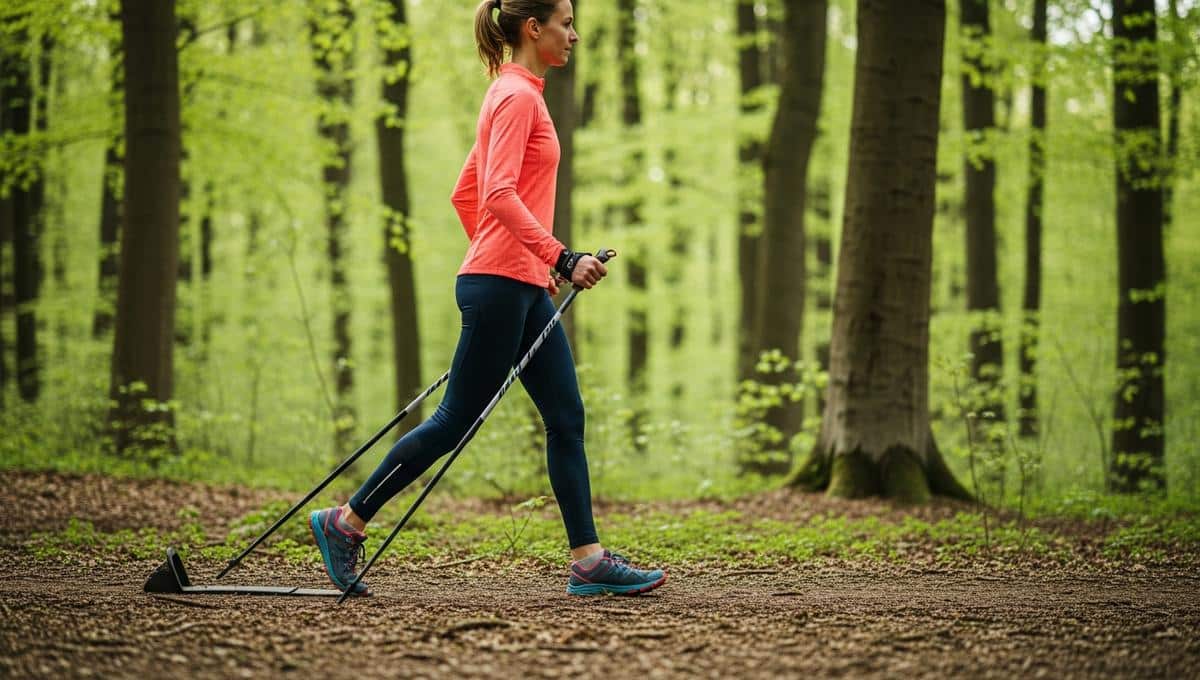
You might think a simple walk with poles is just a casual stroll. Yet this activity engages far more muscles than you realize. In fact, seven key muscle groups work together during each step, transforming your outing into a full-body workout.
Why walking with poles changes everything
Nordic walking has gained popularity across Europe and beyond. This practice originated in Finland during the 1930s as summer training for cross-country skiers. Today, millions of people embrace it for its remarkable health benefits.
Unlike regular strolling, using poles activates your upper body in a meaningful way. Your arms, shoulders, and core muscles join the effort with each stride. As a result, you burn up to 40% more calories compared to standard walking without poles.
The technique requires coordination between your arms and legs. Therefore, your brain stays engaged throughout the activity. This mind-body connection makes the exercise both physically and mentally rewarding.
« Nordic walking is one of the most complete low-impact activities available, engaging nearly 90% of the body’s muscles while remaining gentle on the joints. »
The seven muscles you activate without realizing it
Your latissimus dorsi, the large back muscles, work constantly during pole walking. They pull the poles backward with each push, strengthening your entire posterior chain. Many people notice improved posture after just a few weeks of practice.
To readMakeup after 50: the 4-dot trick is the most effective way to lift drooping eyelids according to a pro artistFurthermore, your triceps fire up every time you push down on the poles. This repeated motion tones the back of your arms effectively. The deltoids in your shoulders also engage to stabilize each movement.
Your core muscles, including the abdominals and obliques, twist gently with each stride. This rotation strengthens your midsection gradually. Meanwhile, your gluteal muscles and quadriceps power you forward with every step.
How to start this rewarding activity
Beginning your pole walking journey requires proper equipment. The poles should reach your elbows when standing straight. Adjustable models work well for beginners who need flexibility.
- Latissimus dorsi – large back muscles for pulling power
- Triceps – arm muscles activated during pole push
- Deltoids – shoulder stabilizers working constantly
- Core muscles – abdominals and obliques for rotation
- Lower body – glutes, quads, and calves for propulsion
Your technique matters more than speed at the start. Plant each pole at a 45-degree angle behind your body. Then push firmly through the strap rather than gripping tightly.
The Decathlon entry-level hiking poles offer an excellent starting point for newcomers. Priced between 12 and 20 euros, these basic models provide the essential features needed to learn proper technique without a major investment.
Start with short sessions of 20 to 30 minutes. Your muscles need time to adapt to this new movement pattern. Gradually increase duration as your confidence grows.
Common mistakes that limit your results
Many beginners hold their poles too tightly. This tension travels up the arm and causes fatigue. Instead, rely on the wrist straps to transfer power smoothly.
Another frequent error involves keeping the arms too stiff. Natural, relaxed movements produce better results. Your elbows should bend slightly throughout each swing cycle.
Some people walk too fast before mastering coordination. Speed without proper form reduces the workout’s effectiveness. Focus on rhythm first, then gradually pick up the pace.
The surprising benefits beyond muscle building
Regular pole walking improves cardiovascular health significantly. Studies show that heart rate increases by 10 to 15 beats per minute compared to regular walking. This boost enhances endurance over time.
To readGarden bugs gone in days: this natural method eliminates them without chemicalsJoint health improves because poles absorb impact forces. Your knees and hips experience less stress during each step. Consequently, this activity suits people with mild arthritis or joint concerns.
Mental wellness benefits deserve attention too. The rhythmic movement releases endorphins naturally. Many practitioners report reduced stress and improved mood after sessions.
A morning walk with poles can set a positive tone for your entire day. The combination of fresh air, movement, and muscle engagement creates lasting energy. Your sleep quality may also improve with regular practice.
Crédit photo © DivertissonsNous